
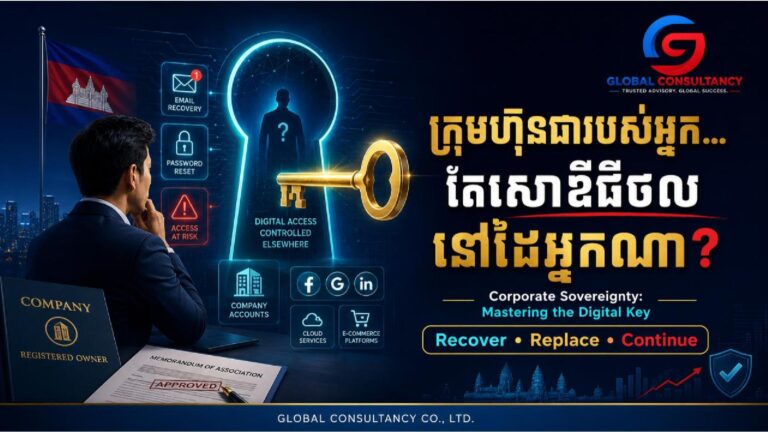
Many business owners assume that legal ownership of a company automatically gives them full control over the company’s digital accounts.
In practice, this is not always true.
The person who controls the registered email address, phone number, password-reset process, administrator account, or two-factor authentication may hold the company’s practical digital power—even when that person is not an owner or director.
Legal Ownership and Practical Control Are Different
A company may legally belong to its shareholders, but access to important online systems may still depend on:
- A former employee’s email address
- An external agent’s telephone number
- A consultant’s administrator account
- A password known by only one staff member
- A recovery email that the company cannot access
When these details are controlled outside the company, the business may struggle to update information, submit declarations, recover passwords, respond to government requests, or continue normal operations.
Why Digital Account Control Matters
Businesses in Cambodia increasingly depend on digital platforms for registration, tax compliance, corporate maintenance, labour administration, accounting reporting, and other regulatory responsibilities.
Losing access to one important account can create delays, missed deadlines, unnecessary costs, and operational risk.
The problem often becomes visible only when:
- A staff member leaves the company
- The business changes its accountant or agent
- A registered phone number becomes inactive
- A password must be reset
- A director needs urgent access
- A government authority requests an update
- The company discovers that recovery information belongs to someone else
By that stage, restoring access may require supporting documents, official letters, identity confirmation, authority communication, and additional time.
The Hidden Risk of Third-Party Dependency
External advisors and service providers can help businesses establish and manage digital accounts. However, the company should remain the ultimate owner of its access information.
The risk is not simply that an advisor may act improperly. Problems can also arise when:
- The responsible person is unavailable
- The relationship ends unexpectedly
- Contact details were never updated
- Account credentials were not formally transferred
- No internal record of the setup exists
- Several people assume someone else is responsible
Without clear ownership and documentation, the company becomes dependent on individuals rather than a controlled business process.
What Businesses Should Control
Every company should maintain an organised register of its important digital accounts.
The register should include:
- Name and purpose of each account
- Registered company email address
- Registered phone number
- Username or account identifier
- Authorised administrator
- Password-storage responsibility
- Recovery email and phone number
- Two-factor authentication method
- Date of the most recent access check
- Procedure for staff or advisor handover
Passwords should be protected securely. They should not be placed in an ordinary spreadsheet that many employees can access.
Questions Directors Should Ask
Business owners and directors should periodically ask:
- Which government and business accounts does the company currently use?
- Who controls the registered email and telephone number?
- Can the company reset the password without depending on an outside person?
- Who receives verification codes and official notifications?
- Is there a documented handover process when staff or advisors change?
- Has account access been tested recently?
- Are former employees or service providers still authorised?
These questions help identify dependency before it becomes an urgent problem.
A Practical Digital-Control Review
A simple review can begin with four steps:
1. List Every Important Account
Create a complete list of government portals, corporate systems, accounting platforms, email accounts, cloud storage, banking access, and other essential services.
2. Verify Registered Information
Confirm the current email address, telephone number, administrator, recovery method, and authorised users for each account.
3. Correct Ownership and Access Gaps
Update outdated contact information, remove unnecessary users, secure recovery access, and transfer control to authorised company representatives.
4. Establish an Internal Control Process
Assign clear responsibility for maintaining the register, approving access, reviewing users, and completing formal handovers.
The Main Principle
A company should never discover during an urgent filing, tax audit, corporate update, or management change that it does not control its own digital access.
Legal ownership is important, but practical control depends on who holds the digital keys.
Businesses that organise account ownership, recovery access, and internal responsibilities are better prepared to manage compliance obligations, protect company information, and continue operating when people or service providers change.
Need Help Reviewing Your Company Accounts?
Global Consultancy supports businesses with corporate information reviews, government-account access issues, registered contact updates, compliance responsibilities, and unresolved regulatory matters in Cambodia.
A structured review can help identify access risks before they disrupt the business.